Showing posts with label alfa culture. Show all posts

Thursday, 19 March 2015

Alfaculture – A Sustainable Solution For Livestock Feed Shortage

Invest in hydroponics for the production of forage might seem like an expensive way to feed dairy or beef cattle or other livestock, and in certain situations it could prove very beneficial. For instance, in drought conditions it could provide producers with an excellent source of forage. After all, cattle are able to eat the whole thing, sprout mat and all. Hydroponic forage production, also called as Alfculture can meet the issue of livestock feed shortage.

Misc-014-640x375With hydroponics, plants can be grown in a small amount of water on a mat with added nutrients – but without soil. With hydroponics, you can grow forage in a greenhouse and grow it faster – harvesting in as little as seven to 10 days. Alfaculture requires a hydroponic growing system that has been specifically developed to sprout grain and legume seeds for highly nutritious yet cost-effective livestock feed.

Hydroponic technology allows fresh feed and produce to be grown anywhere. A thousand pounds of barley, wheat or corn grows into 7,000-8,000 pounds of feed in only 10 days. Typically, farmers are widely depends alfaculture for the production of barley grass, which is rich in nutrition to feed their cattle.

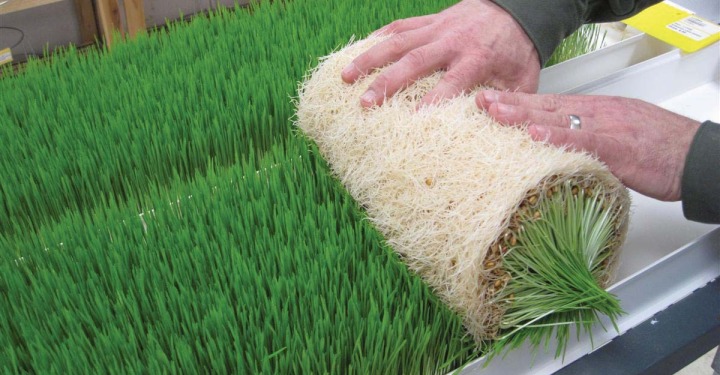
Almost all kind of seeds responds to the system of Alfaculture very soon; means the farmers can have the yields within eight or ten days from the seeding. The addition of a low dose of organic fertilizer helps the successful plant growth with desired results. In an Alfaculture system, when the forage is grown, producers only need to just roll it up, grass and roots together, and feed it to their cattle.

Hydroponics is becoming more important to farmers worldwide due to the lack of land. For instance, the Alfaculture system has been used by dairy producers with limited pasture land. They can grow their forage in a hydroponic system, rather than having to find more land. And they can grow it in any climatic conditions, even it might prevent cattle from foraging for nutritious grass.

Livestock-Production-System-in-the-Middle-East1-720x375Livestock farmers around the world have to focus on more intensive farming with harsher conditions and a lack of land. It is not easy to grow good quality hay in drought conditions, and often pasture or crop land is not available or is very expensive.

Research on good quality forage which can be produced hydroponically or in Alfaculture has shown that milk yields can be increased in dairy cows, the energy and performance of ruminants is improved; and there is a higher protein content than hay so it is more easily digested.

Wednesday, 14 January 2015

Grow Hydroponic Fodder for Your Livestock

For years we’ve known about the human being health advantages of consuming sprouts & juicing greens, so why not expand the happiness to our farms? As winter is around the corner several of our livestock are relegated to dirty, dry silage; but this can be ignored by employing hydroponic technology. Through the use of a customized NFT (nutrient film technique) channel, you’re able to grow general cereal grains into mineral dense, highly edible, fresh greens.

livestock-forage-hydroponics-720x375The hydroponic fodder can be produced in as little as 7 days and need no fertilizer. Some of the most common grains utilized to make hydroponic fodder are wheat, barley, and Black Oil Sunflower seeds. Several cultivators will make precise grain mixtures to cater to their individual livestock requirements, and some grain firms are even providing pre-mixed rations. This type of fodder can be nourished to a wide range of livestock ranging from chickens & turkeys to horses and cattle. The hydroponics fodder imitates these livestock’ normal diets much better than that of dried hay, and standard grain mixed rations. In several cases, nourishing hydroponics fodder in the months of winter can even help decrease the cases of foundering and colic in livestock like cows and horses.

VBK-AGRI_124842f-636x375One of the biggest obstructions that we encounter while cultivating sprouts for our livestock is producing a mold-free stuff while still upholding a higher level of sprouting. What makes this challenge is the fact that both sprouting seeds & fungal pathogens flourish in high moisture, warm conditions. By employing hydroponic NFT skill, newer fodder systems decrease ambient water and moisture loss often concerned with older misting type systems. This decrease in ambient moisture and enables us to employ these systems in a little warmer condition, motivating fertilization, but not mold expansion. Some of the most effective hydroponic fodder systems are operated in exceedingly regulated conditions employing ecological control tools often seen in indoor cultivation complexes and green house.

Hydroponic fodders are steadily getting fame with farms of all sizes. Whether you’re looking to improve the quality of your livestock’s life or to lessen the high rate of hay, hydroponic fodder is the best ever solution.

Monday, 27 October 2014

Enjoy Growing Hydroponic Veggies in Your Own Garden

Hydroponic basically means growing vegetables or plants without using soil. All needed food supplements for the vegetation are known as hydroponic supplement, which are melted in the water & directly fed to the roots mechanically.

Just imagine growing vegetables without even having to worry about the soil type. No more concerns regarding too much or too little water; how much manure or when to fertilize; or the hard work of ploughing & weeding to offer just the perfect soil uniformity & quality; and how much room to provide each plant to ignore from going after water and nourishment.

hydroponics-346x154
Hydroponic veggies are dynamic, healthy and always dependable. Moreover, hydroponic gardening is very clean and effortless, requiring very little hard work. You can yield at the top of nutrition worth, when vines ripened, & they taste wonderful.

In soil, plants develop a big root system to look for water and food. However, in hydroponic method water and foods are directly fed to the root. This allows the foliage to invest more energy on growing the branch on top of the surface, therefore, growing 2 times quicker. With tiny roots, the plants can be grown more closely, preserving much space. Hydroponic gardens need only about twenty percent of the total space required for soil gardens for the same vegetable production.

Common benefits of hydroponic vegetable production:

• Vegetables produced hydroponically can be of great quality and require very little cleaning.

• Soil preparation & weeding is decreased or abolished.

• It’s absolutely possible to produce extremely high yields of veggies on a small area. All the supplements that the plants require are accessible at all times.

• Water is used more effectively

• You don't require good-quality soil to grow plants or vegetables

• Contamination of soil with unused nutrients is deeply decreased.